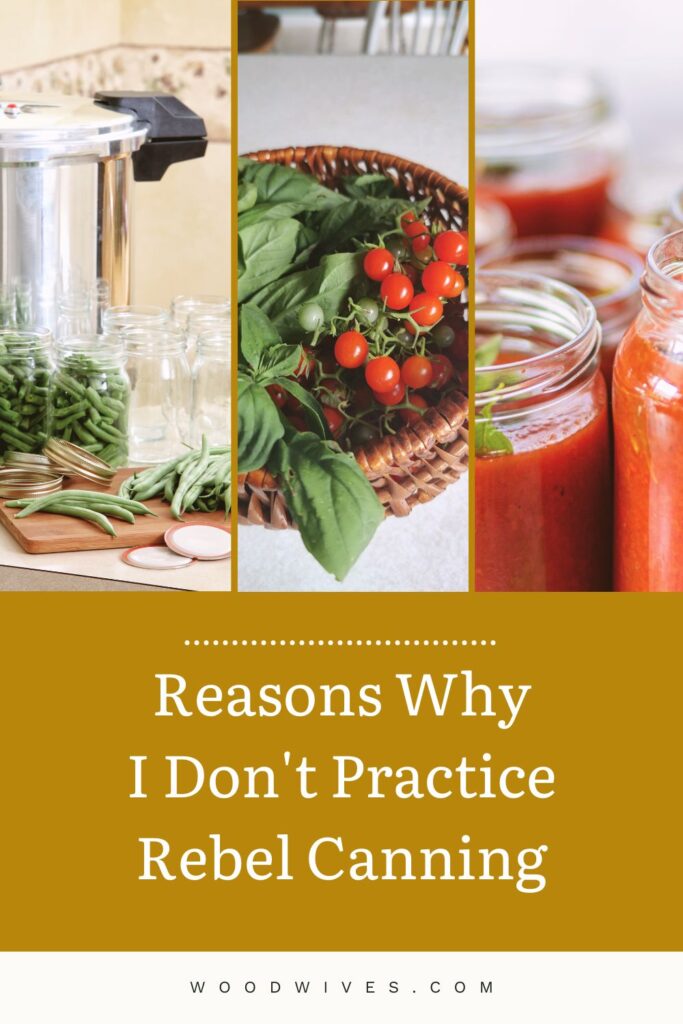
Why I don’t practice rebel canning
Recently, social media decided I was determined to get into rebel canning. I mean, articles, group recommendations, video after video all about rebel canning. So let’s talk about it.
It’s midsummer here, which makes this the perfect time to brush up on canning practices and guidelines. I really hope your garden or your local growers are starting to burst at the seams with tomatoes, peppers, blueberries, and everything else you love this time of year. When your harvest basket overflows, or when in-season produce is suddenly a great deal at the store, of course we want to preserve it for later.
What is rebel canning?
Rebel canning is canning and preserving food in a way that deviates from USDA or other tested, science-backed guidelines.
This might include things like reusing canning lids or water-bath canning dairy products, or taking shortcuts on processing times. It might mean canning green beans or tomatoes the way grandma did. Or perhaps the canner is winging it or going off memory rather than checking a recipe. Or, what I’ve fallen for before, following a video online without checking it against current standards.
There’s a lot of variety in what might fall under the rebel canning umbrella, and not all of it looks equally risky.
Why do people practice rebel canning?
I think a lot of people accidentally do some rebel canning, just because they don’t realize they’re following unsafe practices. This is especially true if they’re using a handed-down method or if they’ve been doing a specific canning method for a long time. However, I don’t think most of these people would consider themselves “rebel” canners though. They likely don’t know there’s anything to question.
The people who do intentionally practice rebel canning have shared a few reasons I found interesting. This isn’t every reason someone might have and they certainly don’t apply to everyone who cans this way, but here are some common things I’ve seen:
- Family traditions passed down through generations
- Distrust in the government and/or the feeling like USDA practices tie into ways of making people more being dependent on them or causing fear
- Canning practices that differ by home region or culture
- A belief that it’s “easy” to tell when a jar has gone bad
- Everyone has their own risk tolerances and some have a different tolerance than official guidelines assume
There is a wide variety of rebel canning practices people might be willing to try. For some, it’s rebel all the way. For others, they have one or two methods they will bend but everything else is according to tested guidelines. And I know that many people who use rebel canning practices are truly concerned with safety. Like with most things, people vary.
Why I Don’t Practice Rebel Canning
However, rebel canning isn’t for me. I feel like over time and testing, and lots of research, we’ve learned a few useful things. To me, it doesn’t feel worth it to ignore those results just because a shortcut is more convenient or feels more nostalgic.
I know my grandma has a few recipes that seemed to work for her and her mother before her. One of those was canning tomato juice. They used an “open-kettle” method, which relies on the heat of the food alone to seal the jars. I remember jars that had gone off, and had to be thrown out.
And I also have family members who talked about getting random stomach aches as kids. Maybe those really were random. Or maybe they came from improper food handling like it often is, including canning, leaving food out, cooking, or otherwise. There’s no way to know for sure now, and that uncertainty alone is enough for me..
In my experience, people who actively practice or defend rebel canning often focus on deaths as the benchmark. “Well, no one I know has died from this recipe or method.” That might be one-hundred percent true for them personally. But ugh, I don’t just want to avoid dying. I’d also really rather not get sick when there’s no good reason for it.
I also think there is some confusion about what an “untested” recipe might be. It doesn’t always mean the recipe has never been tested. It may just mean that researchers have not yet found a recipe that is consistently safe. That is, it varies. Sometimes it works great, but sometimes it doesn’t. My stomach doesn’t want to manage that kind of variable.
And you guys, canning can be SO much work that I would cry if, after all that effort, a jar ended up spoiled or unsafe to eat. I stick with sources that actively research food safety and safe canning practices like the USDA Complete Guide to Home Canning, the Ball Online Canning Guide, and the National Center for Home Food Preservation.
Home canning using tested guidelines still feels like I’m carrying on passed-down kitchen wisdom. It just also happens to come with the reassurance of decades of science backing it up, which is a trade-off I’m happy to make.